
CONCEPTUAL FRAMEWORK
I belong to a generation shaped by the visual culture of the early 1980s — Nintendo, Rainbow Brite, VHS films, science-fiction cinema, and plastic dolls. Growing up in Venezuela, porcelain dolls appeared as unfamiliar objects that awakened my curiosity: inanimate figures that seemed to exist in a parallel world.
For several years I worked with epoxy with the intention of producing doll sculptures. Over time I realized that new forms did not need to be created. Existing objects already carried the presence and histories I was searching for.
Seeing Jan Švankmajer’s film Alice (1988) had a decisive impact on my practice. The film is a surreal reinterpretation of Alice in Wonderland in which everyday objects come alive and the boundary between bodies and dolls constantly shifts through stop-motion animation and live action. From that moment on I began working with porcelain dolls, creating visual narratives in which the figures gradually became characters.
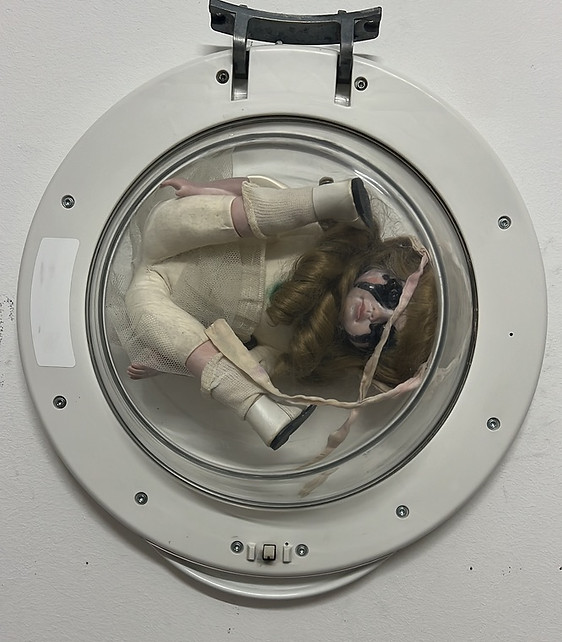
Capsule Archive developed from the need to create a structure where these transformed figures could exist as complete works. The capsules function as a framework that brings together intervention, recycling, and character construction. Each capsule holds traces of memory, allowing the doll to remain suspended and expand its presence in a subtle way, free from the pressure of time.
Replicant Relics takes its name from the world of science-fiction cinema, where artificial beings exist between object and person. Within this body of work, altered porcelain dolls appear as preserved figures whose identities remain uncertain — suspended between character and artifact. Once enclosed, each figure remains fixed as a singular presence, like a recorded fragment held outside ordinary time.
Why Capsule_1877?
Imagine the project as a time capsule.
The year 1877 sits deep within the Victorian era, a period when Europe—particularly France and Germany—were producing bisque porcelain dolls at an industrial scale. This was the golden age of Eurocentric doll manufacturing, where dolls embodied upper-class ideals of femininity: pale skin, glass eyes, delicate features, and refined clothing.
These objects were not innocent toys. They functioned as tools of cultural conditioning, teaching girls domestic roles and reinforcing social hierarchies through play. At the same time, dolls were exported globally, carrying with them the aesthetic codes of empire and colonial power.
In this sense, porcelain dolls became subtle instruments of cultural transmission—propagating ideals of beauty, discipline, and propriety across continents.
Capsule_1877 treats these objects as fragments recovered from a corrupted archive.
Through bending, alteration, and reconstruction, the dolls are removed from their original function and placed inside capsule structures that operate as temporal vessels. Within these capsules, the figures appear suspended outside ordinary time—preserved bodies whose identities are no longer stable.
The archive behaves like a machine attempting to decode femininity.
SYSTEM LOG
CAPSULE_1877
Porcelain archive recovered.
Transmission corrupted.
Subject:
Idealized femininity / Empire aesthetic / Doll object #A-03
Fragments of nineteenth-century beauty standards resurface—
cracked, bent, and reimagined.
Vessel altered.
Memory distorted.
Gender code rewritten.
Begin decolonial reprogramming.


Soy un párrafo. Haz clic aquí para agregar tu propio texto y edítame. Es muy sencillo.
Capsule Taxonomy
Archive Classification System
Each figure in the archive follows a simple classification structure:
CAPSULE CODE
Capsule_[year]
ENTITY NAME
Character name composed of two elements:



Archive Structure
Capsule_001 — Clara Vess
Prototype entity.
Carrier of the original imperial beauty code.
Capsule_1877 — Evangeline Wilde
Victorian archetype.
Peak encoding of idealized femininity.
Capsule_1915 — Marisol Éclat
Early twentieth-century transition.
Capsule_1940 — Rosa Nebula
Wartime mutation of the archetype.
Capsule_1962 — Nia Echo
Civil rights era signal.
Capsule_2001 — Selene Flux
Digital-era instability.
Capsule_2010 — Kaia Raze
Deconstruction phase.
Capsule_2045 — Lyra Pulse
Speculative post-human identity.
Capsule_2099 — Liora Vortex
Future horizon of the archive.


Archive Anomaly
The Eight-Limbed EntityEvery archive eventually produces a specimen that cannot be classified.
Within Replicant Relics this figure appears as an expanded body with eight limbs—a structure that exceeds the physical limits of the original doll form.
Unlike the other figures, this entity cannot be contained inside a capsule.
Capsule_ANOMALY — Octavia DivergenceStatus: Uncontained entityThe figure emerges as a mutation of the archive system itself.Where previous capsules preserve and stabilize bodies, the anomaly expands beyond the structure that attempts to classify it.
The eight-limbed form suggests:
• multiplication of identity
• escape from imposed bodily codes
• the breakdown of the archive's
taxonomy
The system fails to contain this figure.Instead of preservation, the anomaly represents evolution.
Archive Note Porcelain archive recovered.
Transmission unstable.
Beauty standard data corrupted.
Begin decolonial reprogramming.